
Olaf Skoogfors: Sculptural Silver, Surface, and Form
Olaf Skoogfors was born in Sweden in 1930 and came to the United States as a child. His family eventually settled in the Philadelphia area, where he would become one of the important American studio jewelry artists of the mid-20th century.
Although his father was a mechanical engineer, Skoogfors was drawn to making things by hand. The Smithsonian American Art Museum describes him as influenced by his father’s engineering background and as a self-described “constructivist by inclination,” an artist who enjoyed building his compositions directly in metal.
That sense of construction is one of the most compelling qualities of his work. His jewelry does not feel merely decorative. It feels built, shaped, and considered from every angle.
Skoogfors often worked with techniques such as lost-wax casting, fusing, reticulation, and chasing. He was especially interested in surface, form, texture, and the relationship between jewelry and the body. The Smithsonian notes that he drew imagery from nature as well as Scandinavian, Benin, pre-Columbian, Celtic, and Viking traditions.
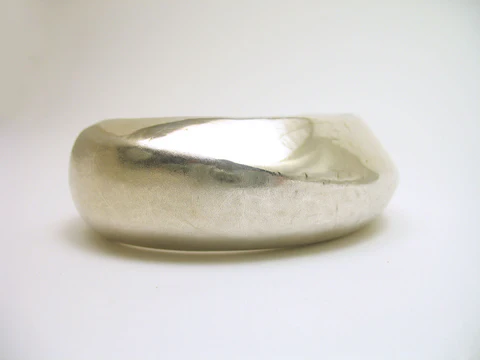
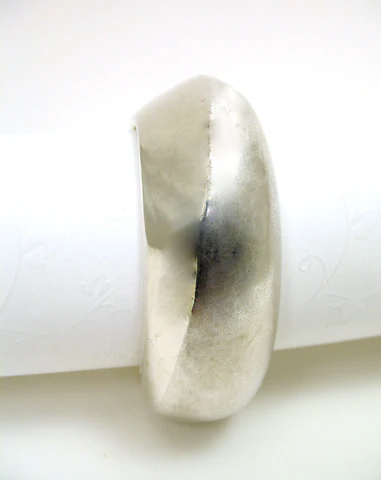
The cuff bracelet shown here is a wonderful example of that sculptural approach.
At first glance, the bracelet appears bold and minimal, with a broad rounded form and a clean modernist silhouette. But the longer you look, the more complex it becomes. A smooth, angled plane moves into a richly textured area, creating contrast between polish and surface. The form has volume, but not heaviness. It feels architectural, yet organic.
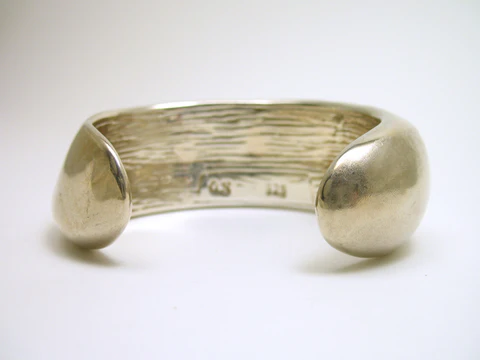
What makes this bracelet especially fascinating is that it is hollow. It is also substantial, weighing approximately 45 grams, or nearly 1.5 troy ounces.
Creating a dimensional hollow form in metal is no small achievement. When hollow sections are fused or soldered together, the air inside expands as it is heated by the torch. Without some way for that air to escape, the pressure can distort the piece and, in extreme cases, cause it to rupture. On this bracelet, there is no obvious visible escape point, which makes the construction even more intriguing.
The inside surface is also beautifully worked, with a chased texture that resembles tree bark. This detail matters. It shows that the interior was not treated as an afterthought. The bracelet was considered as a complete object: outside, inside, surface, structure, and wearability.
Skoogfors had a distinguished career as a metalsmith, artist, and educator. He taught in Philadelphia and was associated with the American studio craft movement. His work was included in exhibitions, and examples are held in museum collections, including the Smithsonian American Art Museum and the Philadelphia Museum of Art.
He passed away in 1975 at only 45 years old, making his body of work relatively limited. That scarcity, combined with the strength and individuality of his designs, helps explain why his jewelry remains sought after by collectors of American modernist studio jewelry.
This cuff is more than a bracelet. It is a small sculptural object, a study in surface and construction, and a beautiful example of jewelry made by an artist who understood metal as both material and language.
Sources & Further Reading
- Smithsonian American Art Museum — Artist biography for Olaf Skoogfors, including his constructivist approach, direct metal construction, and influences.
- Philadelphia Museum of Art — Collection and exhibition references for Olaf Skoogfors.
- Ganoksin — “A Dedication to Olaf Skoogfors,” with personal and professional reflections on his work and influence.
- Archive.org — Olaf Skoogfors: 20th Century Goldsmith, 1930–1975, exhibition catalogue.
- The Magazine Antiques — “Cradle of Liberty, Cradle of Craft,” discussing Philadelphia’s role in American studio craft and referencing Skoogfors.